
Quick answer
When multiple drains clog at once, it usually means the restriction is not in one sink or one shower. It is often in the main drain or sewer line, and the lowest drain in the house (often a basement floor drain) is where backup shows up first. Stop running water, check which fixtures are affected, and if there is any sewage risk use the Sewer Backup First-Hour Checklist before damage spreads.
When symptoms involve more than one fixture, the problem may be deeper than a local clog. See our main sewer line clog service in Hamilton for the warning signs and next steps.
What it means when multiple drains clog at once
A single clogged sink is usually a local problem. But when two or more drains are slow, gurgling, or backing up around the same time, your plumbing is telling you something bigger is happening.
Think of your home’s drainage like a tree.
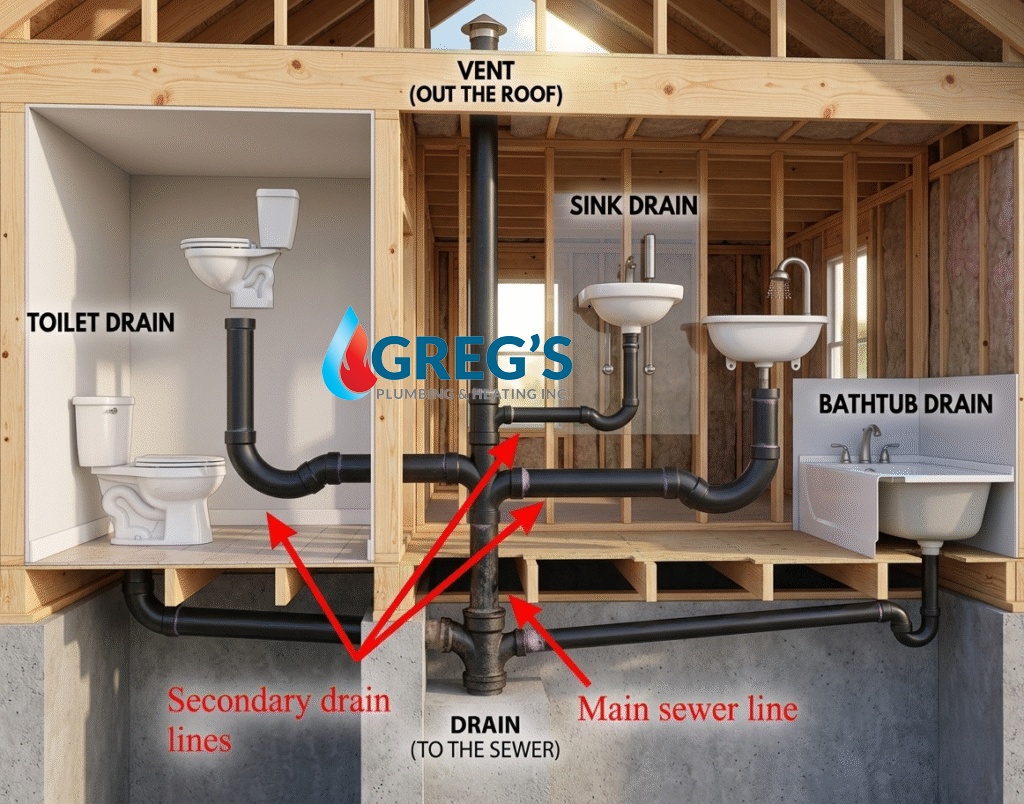
Smaller branch lines (sinks, tubs, showers) feed into a larger trunk line (the main drain), which then flows out to the sewer. If the trunk line narrows or blocks, everything upstream starts acting up together.
The most common “multiple drain” patterns we see
Here are the combos that most often point to a main line restriction:
| What you notice | What it usually means |
|---|---|
| Toilet gurgles and tub drains slow | Main drain is partially restricted |
| Kitchen sink backs up and basement floor drain is wet | Backup is finding the lowest point |
| Shower drains slow and toilet water rises slightly | Main line is struggling to vent and drain |
| More than one fixture backs up when laundry runs | High flow is exposing a main restriction |
A good rule: the more fixtures involved, the less likely it’s a simple clogged P-trap. If you’re dealing with sewage risk or basement water, start with the right service page so you don’t waste time on the wrong fix: Sewer Backup Repairs.
Why the basement is often the first warning sign
In many Hamilton homes, the basement floor drain, basement shower, or laundry area is the lowest point. When the main line can’t carry water away, that’s where it can surface first. Homeowners often describe it as “the basement drain started bubbling” or “the floor drain got a bit of water,” then later the upstairs fixtures slow down too.
If the lowest fixture in your home is starting to smell, bubble, or take on water, read Basement Floor Drain Backing Up or Smells in Hamilton to understand what that usually means and what to do first.
Signs the problem is in the main sewer line
If you’re trying to figure out whether this is a local clog or a main sewer line issue, these signs are the ones that matter most.
1) Two or more drains are slow at the same time
Not just one bathroom sink. You’ll see slow drains in multiple areas: a tub and a toilet, or a kitchen sink plus a shower.
2) Gurgling sounds after flushing or draining water
Gurgling is trapped air trying to escape past a restriction. Toilets often gurgle first because they move a lot of water quickly. If the toilet is part of the problem, especially if flushing makes another drain gurgle or rise, see Toilet Backing Up in Hamilton for the key difference between a toilet clog and a main line issue.
3) Backup shows up at the lowest drain
If a basement floor drain, basement shower, or laundry tub is bubbling or backing up, that is a classic main line warning sign. This is also when a “drain cleaner” approach becomes risky because you may have sewage involved.
4) The problem gets worse when you run multiple fixtures
A partial main line blockage can seem “okay” until you run a shower and flush a toilet, or until the washing machine drains. Then it can’t keep up and things back up fast.
5) It improves briefly, then comes back
If you’ve plunged, snaked a small line, or poured hot water and it “helped,” then everything slowed again a day later, that often means the main restriction is still there and you only pushed through temporarily.
If these symptoms match what you’re seeing, the next step is usually confirming it properly, not guessing. That’s where a camera inspection saves time and repeat service calls. We’ll cover that next, along with what to do right now to prevent a basement mess. See our main sewer line clog service in Hamilton for the warning signs and next steps.
What to do right now
If multiple drains are clogged at once, do not treat it like a single sink clog. The safest move is to assume the main drain may be restricted until you prove otherwise.
1) Stop sending more water into the system
Pause the washing machine, dishwasher, showers, baths, and avoid repeated flushing. A partially blocked main line can seem manageable right up until one more high-flow drain cycle pushes water back to the lowest point in the house.
2) Check the lowest fixtures first
In many Hamilton homes, the first visible warning sign shows up in the basement.
Look at:
- basement floor drain
- basement shower
- laundry tub
- lower-level toilet
If water is already appearing there, that is a strong sign the issue is farther down the system than one local trap.
3) Note what triggers the backup
This helps narrow the diagnosis fast.
| Trigger | What it often suggests |
|---|---|
| Only one sink causes trouble | More likely a local branch clog |
| Laundry makes multiple drains react | Main line struggling under high flow |
| Toilet flushing causes gurgling elsewhere | Main drain or venting issue |
| Heavy rain makes it worse | Possible outside sewer or surcharge issue |
4) Don’t use chemical drain cleaners

They rarely solve a main line problem, and they can create splash risk, pipe damage, and a more dangerous work area if sewage is involved.
5) Use the right next step based on severity
If you are trying to decide whether this is “watch it closely” or “call now,” use the Drain Clog Severity Checker. If there is any water or sewage coming up from a basement drain or fixture, the City of Hamilton also tells homeowners to report it and provides next-step guidance.
If backup has already started, this is the next internal read to follow step by step: Sewer Backup in Hamilton — Your First 60 Minutes.
When it’s a sewer backup emergency
Not every slow drain is an emergency. But once multiple fixtures are involved, the line between “annoying” and “urgent” gets thin.
Treat it as an emergency if any of these are happening.
Sewage or dirty water is coming up from a basement drain
This is the clearest red flag. Stop using water immediately and keep people and pets away from the area. If backup has already started, follow Sewer Backup in Hamilton — Your First 60 Minutes so you don’t make the mess worse while waiting for help.
Water is rising fast when you run fixtures
If the floor drain or basement shower starts filling quickly when a toilet flushes or the washer drains, the main line may be close to fully blocked.
You have a finished basement or stored contents at risk
Even a small backup can damage flooring, drywall, trim, furniture, and stored items fast. Waiting to “see if it clears” is usually the expensive move.
It’s happening during or after heavy rain
The City of Hamilton notes that basement flooding and sewer backup risk can increase during major storm events, and the city has preparedness and protective plumbing information for homeowners.
You smell sewage plus multiple drains are acting up
That combination strongly suggests wastewater is not moving out the way it should.
If you are already in active backup territory, go straight to Sewer Backup Repairs. If you want the broader city-level prevention and response guidance, Hamilton’s basement flooding pages are also worth bookmarking for homeowners.
Common causes in Hamilton homes
When multiple drains clog at once, the cause is usually somewhere beyond one fixture. These are the patterns we see most often in Hamilton-area homes.
Partial blockage in the main sewer line
This is the most common one. The line is not fully blocked yet, but it cannot keep up. That is why drains may be slow for days or weeks before the first real backup.
Grease, sludge, wipes, paper buildup, and debris can all narrow the pipe enough to create house-wide symptoms. Municipal wastewater guidance consistently warns that materials that harden or settle in sewer pipes contribute to blockages and backups.
Tree roots in older sewer laterals
This matters a lot in older neighbourhoods. Roots get into tiny openings in older pipes, then expand and catch paper and waste. That is why the problem often comes back after a temporary clearing.
Regional wastewater guidance also notes that sanitary sewer backups can occur when tree roots grow into or through sewer lines, and that long-term correction usually means more than just another basic clearing.
Heavy buildup in older pipes
Some homes have years of residue coating the inside of the line. In those cases, a simple punch-through with a snake may restore flow briefly, but it does not fully clean the pipe wall.
That is where the cleaning method matters. Our drain cleaning page is the best internal starting point if symptoms are building but you do not yet know the exact cause.
Broken, offset, or sagging sewer line
If the same issue keeps coming back, there may be a structural defect in the line. A belly, offset joint, or cracked section can catch solids over and over again.
This is where a visual confirmation matters most. That is exactly why we use onsite camera inspection instead of guessing.
Storm-related surcharge or outside sewer issue
During very heavy rain, the issue may not be entirely inside the house. Hamilton provides homeowner information on basement flooding preparedness, sewer backup reporting, and protective plumbing devices such as backwater valves.
FAQ: multiple drains clogged at once
1) Why are multiple drains clogged at once?
When multiple drains clog at once, the problem is usually not at one sink or one shower. It often means there is a restriction in the main drain or main sewer line, so more than one fixture starts reacting at the same time.
2) How do I know if it is the main sewer line?
Common signs include two or more slow drains, gurgling toilets, a basement floor drain backing up, and problems that get worse when you run multiple fixtures or the washing machine.
3) Can a toilet clog cause other drains to back up?
A single toilet clog usually affects that toilet only. But if flushing the toilet makes a tub, shower, or basement drain react, that points more to a main line restriction than a simple toilet blockage.
4) Why does my basement floor drain back up when other drains are used?
The basement floor drain is often the lowest opening in the house. When the main drain cannot carry water away fast enough, water may rise there first when you run showers, sinks, or laundry.
5) Will snaking fix multiple clogged drains?
Sometimes, but not always. Snaking can open a focused blockage, but if the real issue is roots, heavy buildup, or a damaged line, the symptoms may come back. That is why a camera inspection is often the smarter next step for repeat problems.
6) When do I need a camera inspection for clogged drains?
A camera inspection makes sense when multiple drains keep clogging, the basement floor drain has backed up more than once, or the line was cleared before and the problem returned. It shows whether the cause is buildup, roots, or pipe damage.
7) When is hydro jetting better than snaking?
Hydro jetting is usually better when the line has thick sludge, grease, or heavy buildup along a longer stretch of pipe. Snaking is often better for a more focused blockage. The right choice depends on what is actually in the line.
8) Is multiple drains clogged at once an emergency?
It can be. If sewage is coming up, the basement floor drain is backing up, or water rises quickly when you use fixtures, treat it as urgent. Stop using water and call for same-day help.


