A running toilet, slow floor drain or small pipe leak can quickly become a costly disruption in a commercial building. The result may be water damage, tenant complaints, higher utility bills or an unexpected shutdown.
This Commercial Plumbing Maintenance Checklist helps Hamilton property managers, landlords and facility managers identify problems earlier and organize monthly, quarterly and annual inspections.
Preventative maintenance is especially important in offices, restaurants, apartment buildings, retail properties and industrial facilities where one plumbing failure can affect several tenants or critical business operations.
Some visual checks can be completed by building staff, while testing, repairs and detailed inspections should be handled by a qualified plumber. Greg’s Plumbing & Heating provides commercial plumbing services in Hamilton, including preventative inspections, drain and sewer service, backflow testing, water-heater work and emergency repairs.
Why Commercial Plumbing Maintenance Matters
Commercial plumbing systems often serve more people, contain more fixtures and operate for longer hours than residential systems. This means a relatively small defect can waste more water or affect more occupants before it is discovered.
Preventative plumbing maintenance helps property managers address six major operational risks.
Avoid Unexpected Building Shutdowns
A severe drain blockage, failed water heater or burst connection can force a business to close washrooms, kitchens, treatment rooms or an entire section of a property.
The consequences may include:
- Tenant complaints
- Lost operating time
- Cancelled appointments
- Temporary washroom closures
- Emergency contractor callouts
- Damage to tenant spaces or inventory
- After-hours access and security complications
Routine inspections allow property managers to identify warning signs such as recurring clogs, corrosion, fluctuating hot water and moisture around pipe connections before the system fails completely.
Reduce the Risk of Water Damage
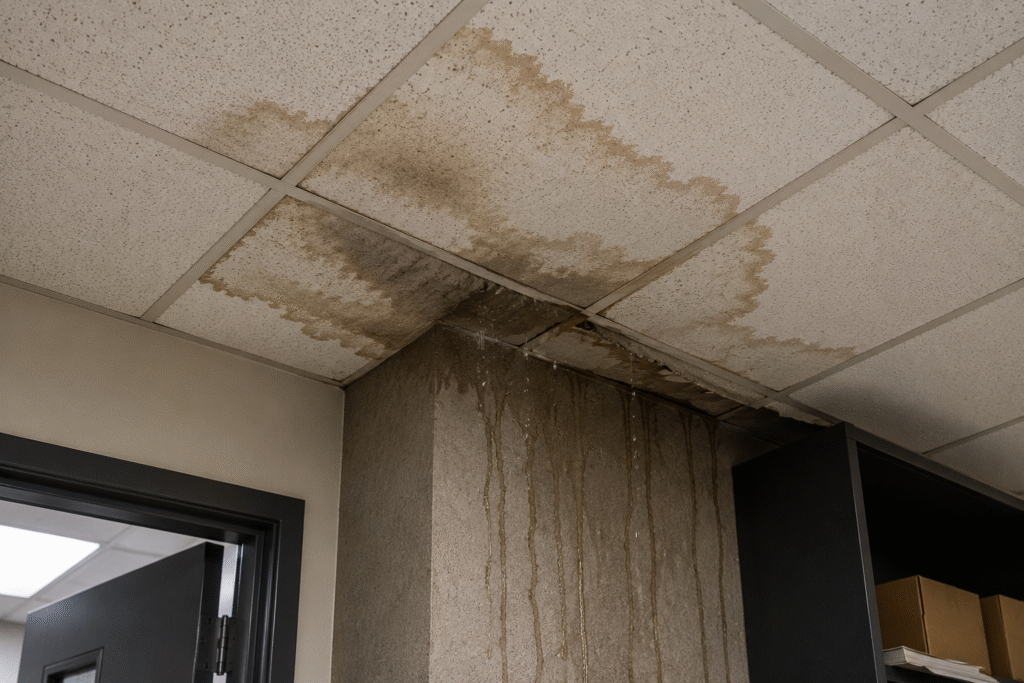
Commercial water damage does not always begin with a dramatic pipe burst. Many incidents start with a slow leak behind a fixture, beneath a sink or near mechanical equipment.
A small amount of moisture can gradually damage:
- Drywall
- Ceiling tiles
- Flooring
- Cabinets
- Insulation
- Electrical components
- Tenant merchandise
- Stored documents or equipment
Monthly visual checks are especially important in concealed or low-traffic spaces, including janitorial rooms, mechanical rooms, storage areas and cabinets beneath staff kitchen sinks.
Extend the Life of Plumbing Equipment
Fixtures and equipment tend to last longer when minor problems are corrected early. A loose faucet, leaking valve or poorly draining fixture places unnecessary stress on surrounding components.
Preventative commercial plumbing maintenance can help extend the useful life of:
- Faucets and flush valves
- Toilets and urinals
- Shutoff valves
- Water heaters
- Boilers
- Circulation pumps
- Backflow prevention assemblies
- Drainage piping
Maintenance records can also help owners plan equipment replacements instead of waiting for a failure that requires an urgent purchasing decision.
Control Water and Energy Costs
Running toilets, leaking faucets and hidden pipe leaks can increase metered water use without creating an obvious puddle.
Hot-water leaks create an additional operating cost because the building is paying for both the water and the energy used to heat it. Problems with water heaters, circulation systems and temperature controls can also cause equipment to operate longer than necessary.
Hamilton Utilities Billing manages water, wastewater and stormwater utility billing within the City of Hamilton. The City notes that sudden increases in metered water bills may have several causes, including plumbing leaks or changes in water consumption.
Comparing monthly consumption is useful, but property managers should also watch for changes in overnight and weekend usage. A building that is normally unoccupied after 7 p.m. should not continue using large amounts of water unless equipment or scheduled operations explain it.
Maintain a Safe and Functional Building
Reliable plumbing is essential to sanitation, accessibility and normal business operations. Tenants and visitors need working toilets, handwashing facilities, drains and hot water.
Certain buildings also have specialized requirements. Restaurants depend on reliable sinks, floor drains and grease-management systems. Medical and personal-care businesses may require dependable hot water and properly protected water connections. Warehouses and industrial buildings may rely on floor drains, process piping and accessible emergency shutoffs.
Hamilton’s Sewer Use By-law applies to commercial, industrial, institutional and residential users that discharge wastewater into the municipal sewer system. The property or system user is responsible for ensuring that discharges comply with the by-law.
Create Documentation for Owners, Insurers and Contractors
A documented maintenance program makes it easier to demonstrate that the property is being inspected and managed responsibly.
Good records help property managers:
- Track recurring problems
- Compare repair recommendations
- Confirm when equipment was last serviced
- Identify repeated issues in a specific unit
- Provide information during an insurance claim
- Prepare operating budgets
- Plan equipment replacement
- Give contractors an accurate service history
The checklist should record more than whether an item passed or failed. Include the location, date, observation, photographs, work completed and any follow-up deadline.
Monthly Commercial Plumbing Checklist
Monthly inspections should focus on visible fixtures, exposed piping, floor drains and water-consumption patterns. These checks do not replace professional plumbing inspections, but they can help uncover early warning signs between scheduled service visits.
Property managers can use the following table as a monthly inspection summary.
| Inspection area | What to check | Recommended response |
|---|---|---|
| Faucets and fixtures | Drips, loose parts, staining and inconsistent flow | Repair leaks and secure damaged fixtures |
| Toilets and urinals | Continuous running, weak flushing, movement or damaged flush valves | Arrange adjustment, repair or component replacement |
| Visible piping | Moisture, corrosion, damaged insulation and staining | Photograph, isolate when necessary and arrange an inspection |
| Floor drains | Standing water, odours, debris and slow drainage | Clean the surrounding area and investigate drainage or trap problems |
| Water consumption | Unexplained increases and after-hours usage | Compare readings and investigate possible hidden leaks |
| Mechanical areas | Water near heaters, boilers, pumps or valves | Treat active leakage or equipment abnormalities as a priority |
Check Faucets, Toilets and Fixtures
Inspect washrooms, kitchens, staff rooms, utility sinks and other high-use areas. Ask cleaning and maintenance staff to report defects rather than assuming someone else has already submitted a request.
Look for:
- Dripping faucets
- Faucets that do not shut off completely
- Constantly running toilets
- Toilets or urinals that refill repeatedly
- Loose toilets or fixtures
- Damaged handles or flush valves
- Water around fixture bases
- Cracked supply hoses
- Low or inconsistent water pressure
- Staining beneath sinks
- Fixtures that move when used
A running toilet may be easy to miss in a busy public washroom because the sound blends into normal building activity. Inspect each fixture individually and confirm that the refill cycle stops.
Low pressure should also be documented carefully. Record whether it affects one faucet, one room, one floor or the entire building. A problem isolated to one fixture may involve an aerator, cartridge or local valve. A building-wide change may require a broader investigation.
Use a simple fixture log to prevent repeated temporary repairs:
| Date | Fixture location | Problem observed | Immediate action | Follow-up required |
|---|---|---|---|---|
| May 2 | Second-floor men’s washroom | Toilet continues running | Fixture isolated | Replace flush-valve components |
| May 8 | Unit 104 staff kitchen | Faucet dripping | Tenant notified | Inspect cartridge and shutoffs |
| May 15 | Lobby washroom | Low faucet pressure | Aerator checked | Compare pressure at nearby fixtures |
Inspect Visible Pipes and Connections
Walk through accessible areas containing water lines, drainage piping and mechanical equipment.
Pay particular attention to:
- Connections beneath sinks
- Toilet and urinal supply lines
- Janitorial rooms
- Mechanical rooms
- Ceiling spaces with access panels
- Exposed basement piping
- Laundry rooms
- Water-heater connections
- Boiler piping
- Pump and valve assemblies
Look for moisture around joints, corrosion, mineral deposits, staining, damaged insulation and slow leaks beneath equipment.
White, green, blue-green or rust-coloured deposits can indicate that moisture has been present even when the connection is dry during the inspection. Water staining on ceiling tiles, drywall or cabinets should also be investigated rather than simply painted over or replaced.
Pipe insulation should be checked for tears, missing sections and signs that it has absorbed water. Wet insulation can conceal the source of a leak and keep surrounding materials damp.
When moisture is discovered, record:
- The exact location
- Whether the leak is active
- The apparent source
- The materials affected
- Whether water is near electrical equipment
- Whether a shutoff is accessible
- Photographs of the area
- The time the issue was reported
Do not repeatedly tighten corroded fittings or valves without determining their condition. Disturbing a severely deteriorated connection can turn a slow leak into a larger failure.
Check Floor Drains
Floor drains are easy to overlook because they are often located in basements, mechanical rooms, parking areas, commercial kitchens, laundry rooms and janitorial spaces.
Inspect them for:
- Standing water around the drain
- Slow drainage
- Debris accumulation
- Sewage or musty odours
- Dry traps
- Rust or damaged drain covers
- Signs of previous overflow
- Insects around low-use drains
- Water backing up when nearby fixtures operate
An odour does not automatically mean that the sewer line is blocked. In low-use areas, water in the drain trap may have evaporated, allowing sewer gas to enter the building. However, persistent odours, gurgling, recurring standing water or backups in lower-level drains require further investigation.
Avoid treating recurring drain odours with fragrances or repeated chemical drain products. Document when the odour occurs, whether it becomes stronger after other fixtures are used and whether nearby drains are also affected.
Restaurants and other food-service properties should give floor drains extra attention. Hamilton’s sewer requirements place responsibility on commercial users for the wastewater they discharge, making proper grease, debris and waste management an important part of plumbing maintenance.
Review Water Usage
Review the property’s water consumption every month rather than waiting for an unusually large bill.
Compare:
- Current usage against the previous month
- Current usage against the same month last year
- Occupied and vacant-unit consumption
- Weekday and weekend usage
- Normal operating hours and overnight usage
- Consumption before and after major repairs
- Usage changes following a new tenant or operational change
Because one cubic metre equals 1,000 litres, even a small unexplained meter change can represent a meaningful amount of water.
For example, suppose the meter reads 4,862.30 m³ when the building closes and 4,862.55 m³ before it reopens. The difference is:
4,862.55 − 4,862.30 = 0.25 m³
That equals 250 litres of water used while the property was closed.
The reading does not prove that the building has a leak. Automatic equipment, irrigation, cleaning, boilers, humidification systems or overnight operations may explain the usage. It does, however, give the property manager a specific number to investigate.
The City of Hamilton advises that water meters are read monthly and that property owners are responsible for metered consumption, including water lost through leaks. Its water meter information also notes that unusual usage may trigger contact from the billing provider. Property managers should still take their own readings when investigating suspected after-hours water use.
When reviewing unexpected consumption, check for:
- Running toilets
- Dripping faucets
- Irrigation problems
- Leaking water-heater connections
- Failed relief or discharge valves
- Make-up water entering a boiler or heating system
- Underground or concealed leaks
- Cleaning equipment left connected
- Tenant operations outside normal hours
The City of Hamilton states that water meters are read monthly and that unusual consumption may lead to contact from the utility or City. Property managers should still maintain their own readings because an internal record can reveal changes earlier and help connect increased consumption with a particular repair, vacancy or operational event.
For more troubleshooting steps, see Why Is My Water Bill So High in Hamilton?.
Quarterly Commercial Plumbing Checklist
Quarterly inspections should go beyond visible leaks and fixture condition. Property managers should test the components used to isolate plumbing problems, review recurring drainage issues and inspect the equipment that supports the building’s hot-water and heating needs.
Complete these checks every three months, or more frequently in high-use properties such as restaurants, medical facilities, apartment buildings and busy retail locations.
| Quarterly inspection | What to verify | Why it matters |
|---|---|---|
| Shutoff valves | Operation, accessibility and labels | Allows water to be isolated quickly |
| Drains and sewer lines | Flow, odours, recurring clogs and backups | Identifies developing blockages |
| Water-heating equipment | Leaks, temperature and recovery | Reduces hot-water interruptions |
| Backflow devices | Condition, tags and test status | Supports water-safety compliance |
| Previous repairs | Whether the issue returned | Prevents repeated temporary fixes |
Test Shutoff Valves
A shutoff valve is only useful during an emergency if it can be found, reached and operated.
Quarterly checks should include:
- The building’s main water shutoff
- Shutoffs serving individual units
- Washroom isolation valves
- Fixture shutoffs
- Mechanical-room valves
- Water-heater supply valves
- Boiler and hydronic-system valves
- Irrigation shutoffs
- Exterior hose-bib shutoffs
- Valves serving commercial kitchen equipment
Confirm that every critical valve is clearly labelled and that labels match the current plumbing layout. Tenant improvements, renovations and equipment replacements can make older diagrams or handwritten labels inaccurate.
Do not force a valve that is seized, badly corroded or leaking around the stem. Record the problem and arrange for inspection or replacement. Applying excessive force can break the valve or create a leak that cannot be stopped without closing the building’s main supply.
A practical valve register should include:
| Valve ID | Location | Area controlled | Last tested | Condition |
|---|---|---|---|---|
| MV-01 | Main mechanical room | Entire building | July 2026 | Operational |
| UV-204 | Corridor outside Unit 204 | Unit 204 | July 2026 | Difficult to turn |
| WH-01 | Beside water heater | Domestic hot-water system | July 2026 | Operational |
| K-03 | Restaurant rear utility room | Kitchen fixtures | July 2026 | Label missing |
Add the valve register to the building’s emergency plan and store a copy somewhere accessible after hours. Maintenance information locked inside an office is not helpful when water is entering a tenant’s space at midnight.
Property managers should also make sure on-site staff know how to shut off the main water valve safely.
Inspect Drains and Sewer Lines
Review the building’s drainage performance instead of treating each clogged fixture as an isolated incident.
Look for patterns such as:
- The same drain clogging repeatedly
- Several fixtures draining slowly
- Gurgling toilets or floor drains
- Sewage or musty odours
- Water appearing in lower-level fixtures
- Kitchen lines slowing during busy periods
- Laundry drains overflowing during discharge
- Backups following heavy building use
- Previous blockages returning shortly after clearing
One slow sink usually points to a localized problem. Multiple slow fixtures, especially on the same floor or plumbing stack, may indicate a blockage farther downstream.
A recurring clog should not be cleared repeatedly without considering why it keeps returning. Grease, scale, roots, damaged piping, poor slope, foreign objects and pipe offsets can all create repeat drainage problems.
For properties with grease, sludge or frequent main-line restrictions, scheduled commercial drain cleaning and hydro jetting may be more practical than waiting for another complete blockage.
The correct cleaning method depends on the pipe material, condition and cause of the obstruction. Mechanical snaking may restore flow through a localized clog, while hydro jetting can remove broader accumulations from suitable pipes. When the cause is uncertain, a drain camera inspection can help identify roots, corrosion, offsets, grease accumulation or damaged sections before further work is recommended.
If wastewater is already rising from a floor drain or affecting several fixtures, stop using water and arrange sewer backup repair immediately.
Inspect Water Heaters and Hot-Water Equipment
Commercial hot-water problems can affect washrooms, kitchens, cleaning procedures, tenant comfort and business operations. A quarterly visual and operational review can reveal deterioration before the building loses hot water completely.
Check for:
- Water beneath the tank or equipment
- Corrosion around fittings
- Rust streaks on the tank
- Temperature fluctuations
- Longer recovery times
- Insufficient hot water during peak demand
- Unusual banging, popping or rumbling sounds
- Discoloured hot water
- Leaking valves
- Damaged insulation
- Venting concerns
- Error codes or repeated resets
- Changes in operating pressure
- Complaints limited to one area of the building
Record the time and conditions surrounding hot-water complaints. For example, “not enough hot water” is less useful than “third-floor tenants lose hot water between 7:30 and 9:00 a.m.”
The second report helps a plumber evaluate whether the issue involves capacity, recovery, circulation, controls or equipment condition.
A useful quarterly equipment record includes:
| Item | Information to record |
|---|---|
| Equipment type | Storage tank, tankless unit, boiler or combined system |
| Manufacturer and model | Taken directly from the rating plate |
| Installation date | Exact date when available |
| Current issue | Leak, noise, temperature or recovery problem |
| Frequency | Constant, intermittent or peak-demand only |
| Error codes | Photograph before resetting |
| Recent repairs | Date, work completed and parts replaced |
Greg’s Plumbing provides commercial water-heater and boiler services for repair, maintenance, replacement planning and urgent equipment failures across the Hamilton area. The service includes assessing piping, valves, controls, venting, pumps, pressure and whether the equipment still matches the building’s demand.
Check Backflow Prevention Equipment
Backflow prevention devices protect the drinking-water system from contamination caused by reverse flow through a cross-connection.
Hamilton’s Backflow Prevention Program applies to covered industrial, commercial, institutional and multi-residential properties. Requirements can include property surveys, device installation, testing and submission of reports, depending on the water-service size and the property’s risk classification. Property managers can review the City of Hamilton Backflow Prevention Program to confirm the applicable requirements and deadlines.
During quarterly checks, look for:
- Visible leakage
- Corrosion
- Physical damage
- Missing caps or components
- Water around the assembly
- An unreadable or missing identification tag
- An expired or missing test tag
- Changes to connected equipment
- Renovations that may have created new cross-connections
- Restricted access to the device
Property managers should maintain copies of surveys, test reports, repairs and City correspondence. Do not assume that a previous tenant’s records are complete or that a device remains compliant after the building’s use changes.
For example, converting a standard retail unit into a restaurant, dental office, salon or industrial workspace may introduce different plumbing equipment and cross-connection risks.
Greg’s Plumbing provides backflow prevention testing, repair, replacement and installation in Hamilton. Testing should be completed by an appropriately qualified professional, and failed devices should be repaired and retested promptly.
Annual Commercial Plumbing Checklist
At least once a year, arrange a more detailed review of the building’s plumbing and mechanical equipment. Annual maintenance is the opportunity to evaluate system condition, recurring service calls and upcoming capital expenses.
Schedule the inspection far enough in advance that non-urgent repairs can be completed without disrupting tenants or customers.
Schedule a Professional Building Plumbing Inspection
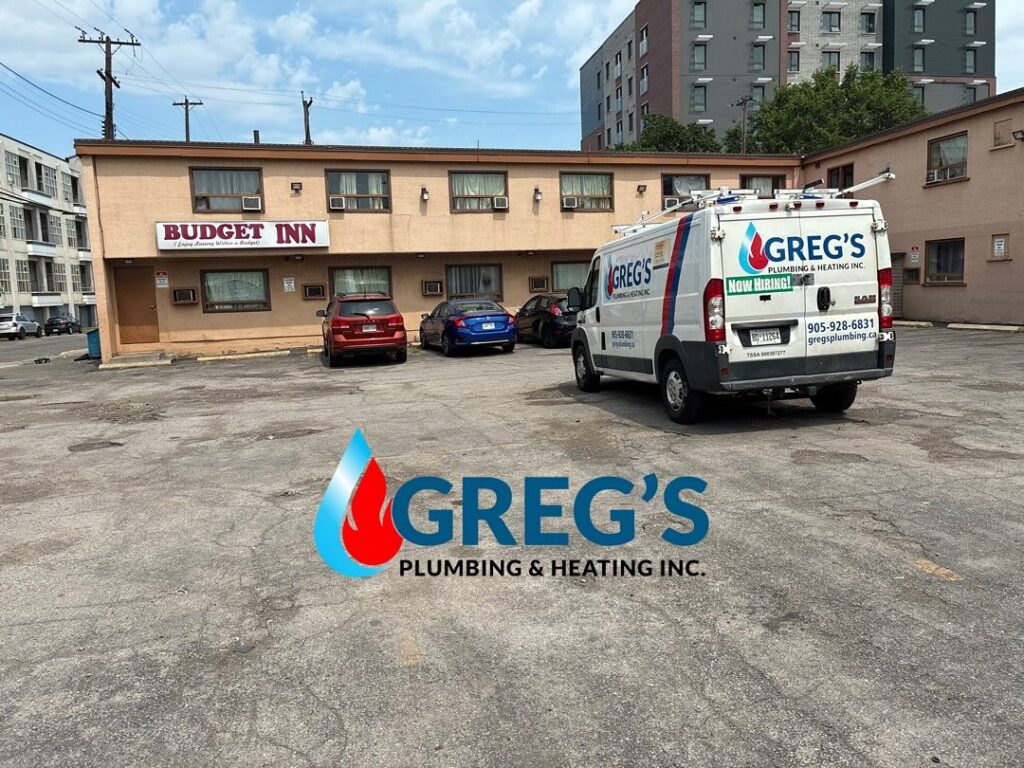
An annual building plumbing inspection should be adapted to the property rather than treated as a generic walk-through.
The scope may include:
- Domestic water-supply piping
- Visible drainage and vent piping
- Public and staff washroom fixtures
- Unit-level plumbing
- Main and local shutoff valves
- Commercial water heaters
- Boilers and circulation equipment
- Backflow prevention devices
- Sump pumps
- Floor drains
- Sewer cleanouts
- Grease interceptors
- Laundry and kitchen connections
- Outdoor plumbing
- Previous leak locations
- Areas with recurring tenant complaints
Ask the plumber to separate observations into practical priorities.
| Priority | Meaning | Example |
|---|---|---|
| Immediate | Active risk or failure | Leaking tank, sewage backup or unsafe equipment |
| Near term | Repair should be planned soon | Corroded valve or unreliable pump |
| Monitor | No immediate failure, but deterioration is present | Early corrosion or intermittent noise |
| Capital planning | Replacement should be budgeted | Aging equipment with repeated repairs |
This format helps property managers explain recommendations to owners and boards. It also prevents legitimate maintenance needs from being lost inside a long inspection report.
For a broader review of what a plumbing inspection can reveal, see the guide to plumbing inspections in Hamilton and Niagara.
Complete Required Backflow Testing
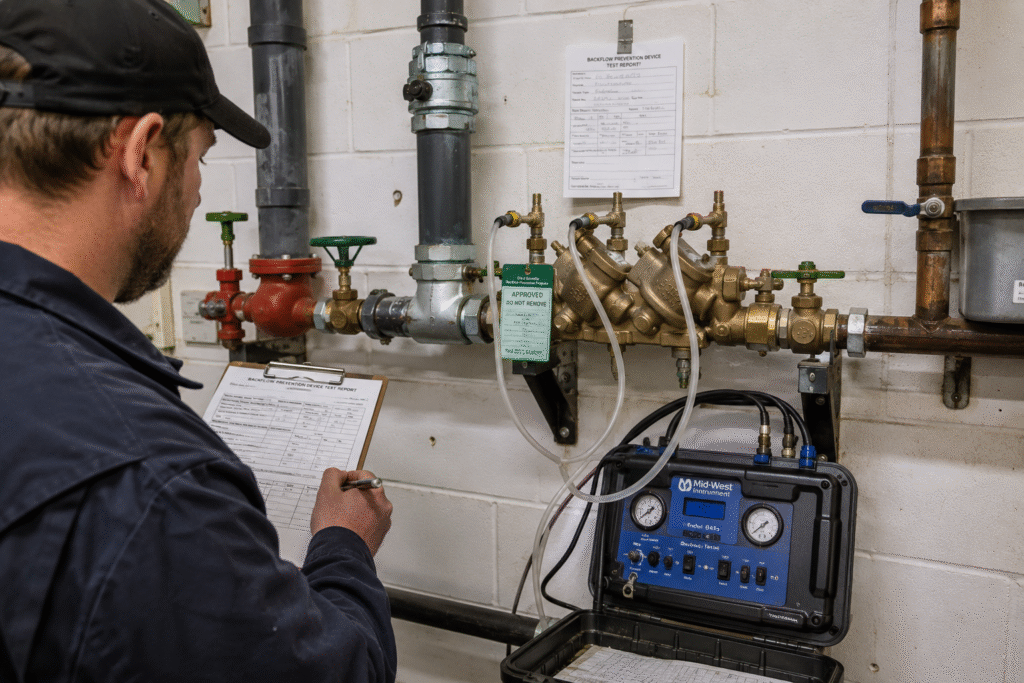
Confirm whether the property is subject to Hamilton’s Backflow Prevention Program and whether any testing, survey or reporting deadline is approaching.
Maintain:
- Device identification
- Device location
- Manufacturer and model
- Serial number
- Previous test date
- Test result
- Repairs completed
- Retest result
- Tester information
- Submitted reports
- Correspondence from the City
Do not wait until the final week before a deadline. A failed device may require repair, parts, replacement and retesting before the file can be closed.
Where annual testing is required, build the due date into the property-management calendar and set reminders 60 and 30 days in advance.
Inspect and Service Commercial Water Heaters
An annual professional water-heater service should consider more than whether the unit currently produces hot water.
The plumber or qualified service professional may review:
- Equipment condition
- Leaks and corrosion
- Water temperature
- Recovery performance
- Capacity during peak demand
- Sediment accumulation
- Valves and piping
- Pressure-relief components
- Controls and sensors
- Venting
- Gas connections where applicable
- Circulation pumps
- Expansion components
- Service access
- Replacement planning
Commercial equipment often serves variable demand. A unit may appear to work normally during a quiet inspection but fail to recover during morning tenant use, restaurant service or a busy appointment period.
Compare the inspection findings with the previous 12 months of complaints and service calls. Three repairs involving the same equipment may support a different decision than one isolated component failure.
Use the annual review to determine whether the equipment should remain in service, receive planned repairs or be placed into the building’s capital replacement budget.
Inspect Commercial Boilers and Heating Equipment

Commercial boilers should be inspected before the main heating season whenever possible. Waiting until the first extended cold period increases the consequences of a failure and may limit scheduling options.
The review may include:
- Visible leaks
- Operating pressure
- Pumps
- Controls
- Valves
- Expansion components
- Corrosion
- Ignition and burner operation
- Venting
- Gas supply
- Unusual sounds
- Uneven heating
- Repeated shutdowns
- Evidence of frequent make-up water
A boiler that repeatedly loses pressure or requires water to be added should be investigated. Continually adding water may temporarily restore operation, but it does not correct the underlying cause.
Greg’s Plumbing provides commercial boiler repair and installation as well as broader heating and cooling repairs for Hamilton-area properties.
Consider a Sewer Camera Inspection
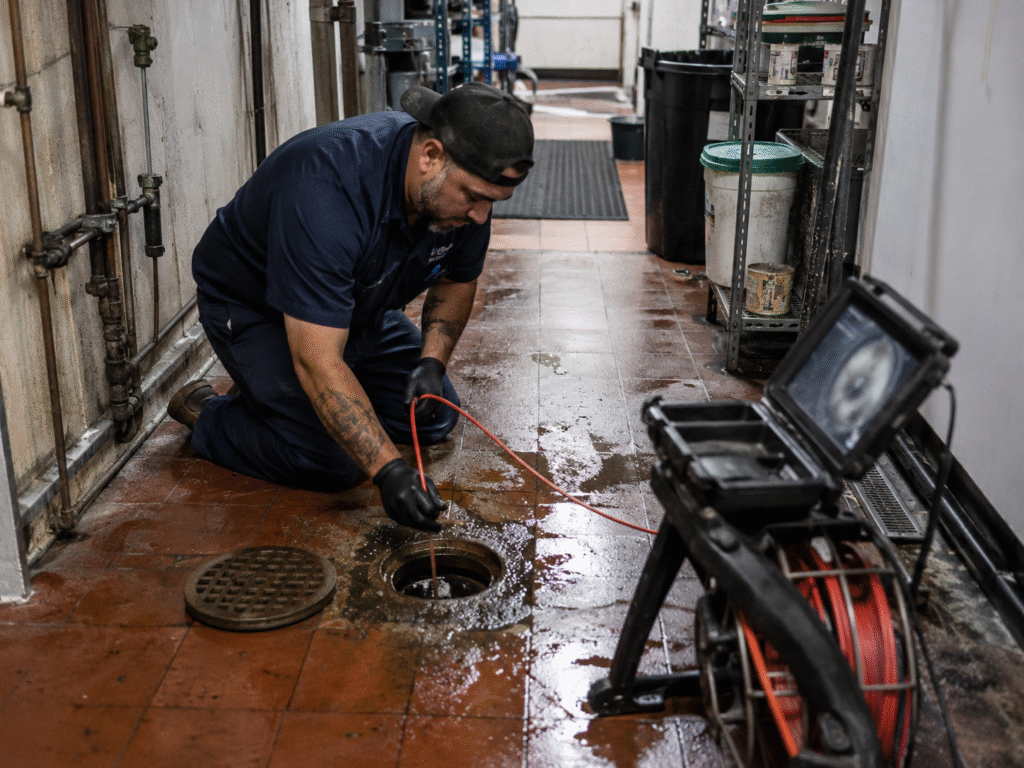
A sewer camera inspection is not automatically required every year for every commercial property. It becomes more valuable when the building has a higher likelihood of hidden sewer problems or a documented history of repeat blockages.
Consider an inspection for:
- Older commercial buildings
- Properties with recurring main-line clogs
- Restaurants and commercial kitchens
- Multi-unit residential buildings
- Properties with mature trees near sewer routes
- Buildings that have experienced a sewer backup
- Sites with older clay, cast-iron or other aging drainage materials
- Buildings being purchased or substantially renovated
- Properties where the sewer route or condition is unknown
A camera inspection can help locate roots, grease buildup, debris, offsets, corrosion, bellies or damaged piping. It can also reduce unnecessary excavation by showing where the problem is located.
Camera footage should be labelled with the date, property address and inspected line. Keep the video and written findings with the building’s maintenance records instead of relying on a verbal description.
Maintenance Recommendations by Property Type
A commercial plumbing maintenance checklist should reflect how the property is used. The risks in a restaurant are different from those in an office, apartment building or warehouse.
Restaurants and Commercial Kitchens
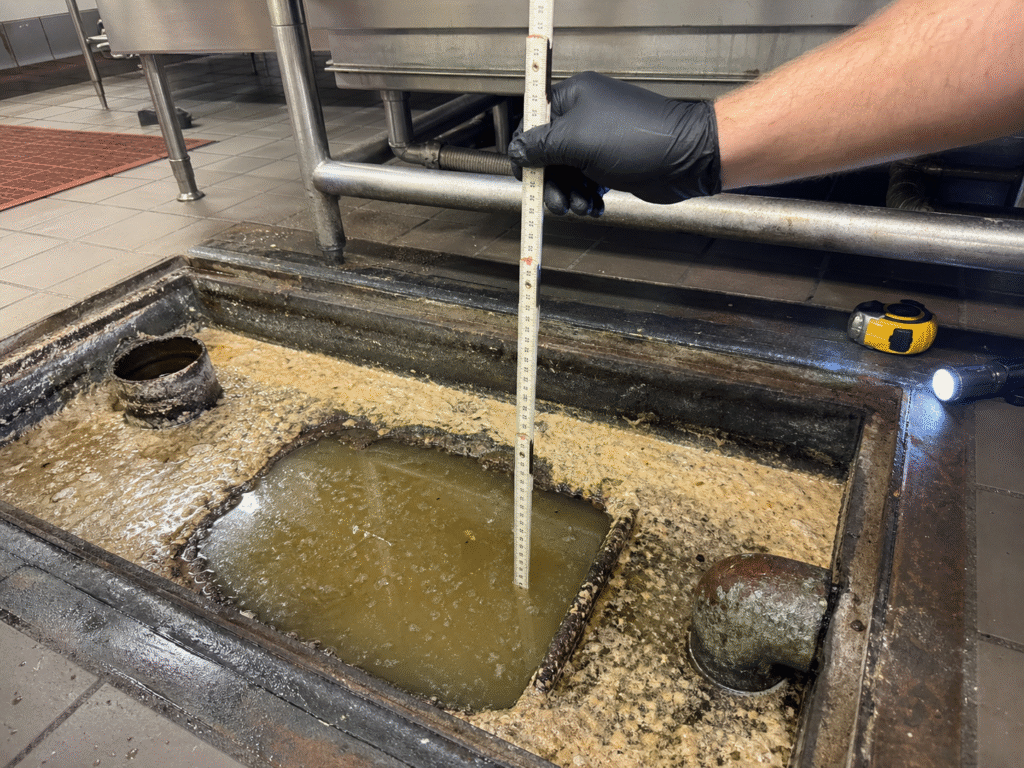
Restaurant plumbing systems handle grease, food debris, high-temperature discharge and heavy fixture use. A drainage problem can affect food preparation, sanitation and the ability to remain open.
Priorities include:
- Grease traps and interceptors
- Kitchen floor drains
- High-volume sinks
- Dishwashing equipment
- Handwashing stations
- Hot-water recovery
- Drain-cleaning frequency
- Waste-disposal practices
- Maintenance records
Hamilton’s requirements for grease interceptors are capacity-based rather than a simple universal calendar. Greg’s commercial grease-interceptor page explains that service is required before grease and solids reach 25% of the unit’s liquid capacity. The only reliable schedule is one based on inspection, measurement and the kitchen’s actual usage.
Property managers with restaurant tenants should clarify in writing who is responsible for inspection, cleaning, documentation and emergency response. Shared interceptors serving multiple tenants require especially clear responsibility.
Commercial tenants and property owners must also consider what enters the municipal sewer system. Hamilton’s Sewer Use By-law regulates commercial and industrial wastewater discharges, including prohibited substances and pollutant limits. The City states that users are responsible for ensuring their discharges comply with the by-law. See grease trap and interceptor services in Hamilton for cleaning, installation and compliance documentation.
Apartment and Condominium Buildings
Multi-unit properties have many fixtures connected to shared supply lines, stacks and sewer piping. A problem originating in one unit may affect neighbouring or lower-level units.
Focus on:
- Shared drainage stacks
- Unit shutoff valves
- Laundry drains
- Basement floor drains
- Mechanical-room equipment
- Domestic hot-water capacity
- Boiler reliability
- Sump pumps
- Tenant reporting procedures
- Access arrangements for occupied units
Give tenants a clear way to report slow drains, leaks and water stains before the issue spreads. The procedure should state whom to contact during business hours, whom to call after hours and what tenants should do during active leakage.
Track repeated complaints by stack or vertical area, not only by unit number. Several complaints from units directly above one another may reveal a shared drainage or supply problem.
Offices and Retail Properties
Office and retail properties may experience fewer high-volume drainage problems than restaurants, but low-use fixtures and after-hours leaks create their own risks.
Inspect:
- Public washrooms
- Employee washrooms
- Staff kitchens
- Janitorial sinks
- Low-use floor drains
- Vacant units
- Utility rooms
- Water lines above finished spaces
- Fixtures vulnerable to vandalism
- Plumbing added during tenant renovations
Vacant commercial units should not be ignored. Include them in monthly inspections and check for dry traps, leaking toilets, frozen-pipe risks and unauthorized use.
After tenant construction, update valve maps, equipment lists and emergency-contact information.
Medical, Dental and Personal-Care Businesses
Clinics, dental offices, salons, spas and other personal-care businesses may have specialized equipment connected to water or drainage systems.
Maintenance should address:
- Specialized equipment connections
- Reliable hot-water supply
- Drainage performance
- Accessible shutoff valves
- Backflow protection
- Cross-connection risks
- Treatment-room sinks
- Equipment discharge
- Renovations or newly added equipment
Property managers should require tenants and contractors to document changes to plumbing connections. A new piece of equipment should not be added without considering drainage, water demand, shutoff access and backflow protection.
Warehouses and Industrial Buildings
Industrial and warehouse facilities may contain larger piping, process water, loading-area drains and mechanical equipment that is not present in a standard office.
Inspect:
- Floor drains
- Process-water connections
- Mechanical rooms
- Large-diameter piping
- Emergency shutoffs
- Backflow assemblies
- Sump and ejector pumps
- Exterior drainage areas
- Boiler and hot-water equipment
- Areas exposed to freezing
- Pipes vulnerable to impact from vehicles or equipment
The maintenance plan should clearly separate standard plumbing from process systems that require specialized contractors or site-specific safety procedures.
Greg’s Plumbing provides industrial plumbing services in Hamilton for drainage, backflow prevention, boilers, gas lines and related commercial systems.
Warning Signs That Require Immediate Attention
Some plumbing problems can be documented and scheduled. Others require immediate action because they may cause water damage, contamination, equipment failure or a building shutdown.
Contact a commercial plumber promptly when you notice:
- Sewage odours that persist after traps are checked
- Multiple slow or gurgling drains
- Recurring clogs affecting the same area
- Wastewater rising from a floor drain
- Visible or active pipe leaks
- Water spreading into occupied spaces
- New ceiling or wall stains
- An unexplained increase in water use
- Sudden loss of hot water
- Water leaking from a commercial water heater
- Boiler pressure problems
- Repeated boiler shutdowns
- Water collecting around a backflow device
- A shutoff valve that cannot isolate an active leak
- Sudden building-wide pressure loss
- Water near electrical equipment
Use the following response guide:
| Warning sign | Immediate action |
|---|---|
| Active clean-water leak | Isolate the affected line or close the main valve |
| Sewage backup | Stop water use and keep occupants away |
| Water near electricity | Avoid the area and isolate power only when safe |
| Leaking water heater | Shut off the water and energy source when safe |
| Boiler malfunction | Do not repeatedly reset unexplained faults |
| Backflow-device leak | Protect the area and arrange qualified service |
| Multiple drains backing up | Treat it as a possible main-line problem |
During active leakage, take photographs after completing immediate safety and shutoff steps. Record the time the problem was discovered, affected units, visible damage and actions taken.
Do not allow documentation to delay containment. The first priority is protecting occupants and stopping additional damage.
For active flooding, sewage backups, burst pipes or plumbing that cannot be used safely, contact emergency plumbing services in Hamilton or call us at 905-928-6831.
Property managers dealing with wastewater coming through a basement or lower-level drain can also follow the sewer backup first-hour checklist while professional help is being arranged.
What Property Managers Should Document
A plumbing maintenance program is more useful when inspections, repairs and recurring issues are documented consistently.
Without clear records, each service visit starts from the beginning. Contractors may not know when a problem first appeared, which repairs were attempted or whether the same blockage has affected multiple units.
Maintain a plumbing file for each property containing:
- Inspection dates
- Problems observed
- Repairs completed
- Photographs and videos
- Contractor reports
- Backflow test reports
- Sewer camera footage
- Equipment model and serial numbers
- Installation dates
- Warranty information
- Shutoff-valve locations
- Emergency contact information
- Recurring issue history
- Estimates and replacement recommendations
A simple maintenance log can be used for routine checks:
| Date | Building area | Issue identified | Action taken | Contractor | Follow-up date |
|---|---|---|---|---|---|
| July 4 | Unit 205 washroom | Toilet running continuously | Fixture shutoff closed | Pending | July 5 |
| July 9 | Basement mechanical room | Corrosion around valve | Photographed and inspected | Greg’s Plumbing | July 15 |
| July 18 | Restaurant floor drain | Drainage slowing during evening service | Drain cleaning scheduled | Greg’s Plumbing | July 22 |
| July 26 | Main water heater | Intermittent temperature drop | Equipment assessment completed | Greg’s Plumbing | Monitor |
Record the Exact Location
Descriptions such as “leak in the basement” are not detailed enough for a large commercial building.
Use specific descriptions such as:
- Mechanical room beside the loading area
- Ceiling above Unit 103
- Second-floor women’s washroom, third toilet
- Restaurant kitchen floor drain beside the dishwasher
- Shutoff valve above the corridor ceiling outside Unit 208
Numbering fixtures, valves and equipment can make future inspections and emergency communication faster.
Photograph Problems Before and After Repairs
Photographs help document:
- The original condition
- The location of concealed valves
- Corrosion or staining
- Equipment labels
- Damage caused by leakage
- The completed repair
- Areas that should be monitored
Include a wider photograph showing where the problem is located and a closer image showing the specific defect.
For sewer camera inspections, keep the video together with a written summary identifying the inspected line, access point, distance travelled and any problem areas found.
Track Recurring Issues by Area
Do not treat every service call as unrelated.
A series of slow drains in vertically aligned apartment units may indicate a shared-stack problem. Repeated backups near the same commercial kitchen may suggest grease accumulation or a damaged section of piping. Ongoing water-heater complaints during peak periods may indicate that the equipment no longer meets demand.
A recurring-issue log should show:
| Location or system | Number of incidents | Period reviewed | Possible pattern |
|---|---|---|---|
| North washroom stack | 4 | Six months | Shared drainage restriction |
| Restaurant kitchen line | 3 | Four months | Grease and food accumulation |
| Main water heater | 5 complaints | Three months | Peak-demand capacity problem |
| Basement floor drain | 2 backups | One year | Possible main sewer issue |
This information allows a commercial plumber to investigate the underlying cause rather than repeatedly addressing the immediate symptom.
Create a Commercial Plumbing Emergency Plan
A written emergency plan helps staff respond quickly when a pipe bursts, sewer backs up or water-heating equipment fails.
The plan should be property-specific and available to building staff, property managers and authorized contractors.
Label Every Important Shutoff Valve
Clearly identify:
- The main building shutoff
- Unit-level shutoffs
- Washroom shutoffs
- Kitchen shutoffs
- Water-heater valves
- Boiler-system valves
- Irrigation valves
- Equipment-specific shutoffs
Labels should explain what each valve controls. A label reading “Valve 6” is not useful unless it matches an accessible diagram or register.
Periodically confirm that the labels remain accurate following renovations, tenant improvements or equipment replacements.
Keep Access Clear
Do not allow storage, shelving, tenant merchandise or mechanical equipment to block:
- Main shutoff valves
- Water heaters
- Boilers
- Backflow devices
- Sewer cleanouts
- Sump pumps
- Floor drains
- Electrical disconnects
- Mechanical-room doors
Emergency access should not depend on locating keys, moving heavy objects or contacting an unavailable tenant.
Identify Critical Plumbing Equipment
Create a list of equipment whose failure could interrupt business operations.
This may include:
- Domestic water heaters
- Commercial boilers
- Circulation pumps
- Sump pumps
- Sewage ejector pumps
- Backflow prevention assemblies
- Grease interceptors
- Process-water equipment
- Main sewer lines
- Plumbing serving medical or food-service equipment
Record the manufacturer, model number, location and energy source for each item.
Establish a Tenant Reporting Procedure
Tenants should know how to report:
- Active leaks
- Slow drains
- Sewage odours
- Water stains
- Running toilets
- Loss of hot water
- Boiler or heating problems
- Backed-up floor drains
- Unusual water pressure
The reporting process should distinguish between routine requests and emergencies.
For example:
| Situation | Recommended reporting method |
|---|---|
| Dripping faucet | Standard maintenance request |
| One slow sink | Standard request with location and photo |
| Several drains backing up | Immediate telephone call |
| Active ceiling leak | Emergency telephone call |
| Sewage entering the building | Stop water use and call immediately |
| Water near electrical equipment | Keep occupants away and call immediately |
Avoid relying only on email for active emergencies. Messages may not be seen until significant damage has occurred.
Document After-Hours Access
Your emergency plumbing plan should explain:
- Who holds building keys
- How contractors enter after hours
- Whether alarm codes are required
- Where mechanical rooms are located
- Which tenants must be contacted
- Who can authorize repairs
- Whether security must attend
- Where water shutoffs are located
- Where contractors can park and unload equipment
Provide emergency contractors with the information necessary to reach the affected area without unnecessary delays.
Know Who Can Authorize Repairs
Plumbing emergencies often become more expensive when no one can approve the work required to stop the damage.
Identify:
- The primary decision-maker
- A backup contact
- Emergency spending limits
- When owner approval is required
- When work can proceed to protect the building
- Insurance notification procedures
Keep Greg’s Plumbing & Heating at 905-928-6831 in the property’s emergency contact list. Emergency plumbing service is available for burst pipes, active leaks, sewer backups, failed water heaters and other urgent commercial plumbing problems.
How Often Should Commercial Plumbing Be Inspected?
There is no single inspection schedule that is appropriate for every commercial property.
The right frequency depends on:
- Building age
- Property type
- Number of occupants
- Fixture usage
- Plumbing materials
- Equipment condition
- Tenant operations
- Previous leaks or backups
- Local requirements
- Manufacturer recommendations
As a practical starting point, property managers can use the following schedule:
| Frequency | Recommended checks |
|---|---|
| Monthly | Fixtures, visible piping, floor drains and water usage |
| Quarterly | Shutoff valves, drainage performance, water heaters and visible backflow equipment |
| Annually | Professional building inspection, equipment service, required testing and replacement planning |
| Immediately | Active leaks, sewage backups, loss of critical equipment or sudden system changes |
Monthly Visual Checks
Monthly inspections are appropriate for identifying visible problems such as:
- Dripping faucets
- Running toilets
- Moisture around fittings
- Staining
- Corrosion
- Slow floor drains
- Damaged fixtures
- Unexpected water consumption
Large properties may divide the building into inspection zones so that every area is checked consistently.
Quarterly Building-Level Checks
Quarterly reviews should focus on systems that affect multiple fixtures or areas, including:
- Shutoff valves
- Main drainage lines
- Mechanical-room piping
- Commercial water heaters
- Boilers
- Backflow prevention assemblies
- Sump and sewage pumps
This is also a good time to review service calls from the previous three months and identify recurring problems.
Annual Professional Inspections
A qualified plumber should inspect the building at least annually as a general maintenance practice, with the scope adjusted to the property.
The inspection may include:
- Water-supply piping
- Drainage systems
- Fixtures
- Shutoff valves
- Water heaters
- Boilers
- Pumps
- Backflow prevention equipment
- Floor drains
- Sewer lines
- Areas with previous leaks
Some systems may have separate inspection, testing or maintenance requirements.
Hamilton’s Backflow Prevention Program applies to covered industrial, commercial, institutional and multi-residential properties. Property managers should confirm the applicable survey, testing and reporting requirements for their specific property rather than assuming every building follows the same schedule.
Properties That May Need More Frequent Maintenance
More frequent inspections or scheduled service may be appropriate for:
- Restaurants
- Commercial kitchens
- Medical and dental facilities
- Salons and spas
- Apartment buildings
- Long-term care facilities
- Older commercial buildings
- High-occupancy properties
- Buildings with recurring drain problems
- Properties with aging piping
- Facilities operating outside standard business hours
Restaurants may require grease-interceptor inspections and drain maintenance based on actual usage rather than a general calendar. Apartment buildings may need closer monitoring of shared stacks, laundry drains and domestic hot-water equipment.
A building that has already experienced multiple sewer backups should not follow the same maintenance approach as a newer office with no drainage history.
Book Commercial Plumbing Maintenance in Hamilton
Preventative plumbing maintenance helps property managers find problems while repairs can still be planned.
Greg’s Plumbing & Heating works with property managers, landlords, building owners and facility teams throughout Hamilton, Burlington, Ancaster, Dundas and Stoney Creek.
Commercial services include:
- Preventative plumbing inspections
- Recurring plumbing maintenance
- Fixture and leak repairs
- Commercial drain cleaning and hydro jetting
- Sewer backup repairs
- Sewer camera inspections
- Backflow prevention testing and repair
- Commercial water-heater and boiler services
- Shutoff-valve replacement
- Emergency plumbing support
- Maintenance and replacement planning
A planned inspection can help identify recurring drainage problems, aging equipment, inaccessible shutoffs and active leaks before they disrupt tenants or damage the property.
Explore our commercial plumbing services or contact Greg’s Plumbing & Heating to arrange service.
Frequently Asked Questions
How Often Should a Commercial Building’s Plumbing Be Inspected?
Property managers should generally complete visual checks monthly, broader building-level checks quarterly and a professional plumbing inspection annually.
More frequent inspections may be appropriate for restaurants, multi-unit buildings, older properties, high-use facilities and buildings with recurring plumbing problems.
The schedule should be based on the building’s age, usage, plumbing materials, equipment condition and maintenance history.
What Should Be Included in a Commercial Plumbing Inspection?
The inspection scope may include:
- Faucets, toilets and urinals
- Visible supply and drainage piping
- Shutoff valves
- Water pressure
- Floor drains
- Sewer cleanouts
- Water heaters
- Boilers
- Pumps
- Backflow prevention devices
- Sump pumps
- Areas with previous leaks
- Recurring drainage problems
A professional inspection should identify immediate concerns, recommended repairs and equipment that should be considered for future replacement.
Who Is Responsible for Plumbing Maintenance in a Commercial Lease?
Responsibility depends on the wording of the lease.
The landlord may be responsible for the building’s main plumbing systems, while the tenant may be responsible for fixtures or equipment serving only the leased unit. Some leases transfer broader repair and maintenance responsibilities to the tenant.
Property managers should review the lease and clarify responsibility for:
- Fixture repairs
- Drain blockages
- Grease interceptors
- Specialized equipment
- Water heaters
- After-hours emergencies
- Damage caused by tenant operations
When responsibility is unclear or disputed, obtain advice from a qualified Ontario legal professional. Plumbing contractors can assess the problem, but they do not determine how repair costs should be allocated under the lease.
How Can Property Managers Prevent Plumbing Emergencies?
Not every emergency can be prevented, but property managers can reduce the risk by:
- Inspecting fixtures monthly
- Monitoring water usage
- Repairing small leaks promptly
- Tracking recurring clogs
- Testing and labelling shutoff valves
- Maintaining water heaters and boilers
- Keeping floor drains and cleanouts accessible
- Scheduling drain maintenance where needed
- Training staff to report warning signs
- Maintaining an after-hours response plan
The most important step is acting on recurring symptoms instead of repeatedly applying temporary fixes.
Should Commercial Drains Be Cleaned on a Schedule?
Some commercial drains benefit from scheduled cleaning, but the correct frequency depends on how the building is used and the history of the drainage system.
Restaurants, commercial kitchens, apartment buildings, salons, medical facilities and high-use properties may require more frequent service.
A maintenance schedule may be appropriate when a property experiences:
- Recurring clogs
- Heavy grease exposure
- Frequent kitchen use
- High occupancy
- Scale accumulation
- Previous sewer backups
- Known root intrusion
- Slow drainage that returns after clearing
A commercial plumber can help determine whether mechanical drain cleaning, hydro jetting or a camera inspection is appropriate.
What Plumbing Records Should Property Managers Keep?
Keep records of:
- Inspection dates
- Repair invoices
- Contractor reports
- Photographs
- Backflow testing
- Equipment servicing
- Sewer camera inspections
- Equipment model and serial numbers
- Installation dates
- Warranty documents
- Shutoff-valve locations
- Tenant complaints
- Recurring issue history
- Replacement recommendations
Records should remain with the property rather than with one staff member or contractor. This gives future managers, owners and service providers an accurate picture of the building’s plumbing history.


