
Hamilton basements face two different flood threats during storms: groundwater rising into your sump pit, and sewer surges pushing backwards through floor drains. Your sump system handles groundwater. A backwater valve protects against sewer reversal. This guide shows you how to test your pump in 3 minutes, decide if you need a battery backup, and when to pair it with a backwater valve. If you’ve had sewer backup before, see our Sewer Backup: First-Hour Checklist and Sewer Backup Repairs.
TLDR (what to do before the storm hits)
- Do a 3-minute test now: confirm power/GFCI, run a float test, listen for the check-valve “thunk,” and skim debris from the pit. If water is already rising, use Emergency Plumbing.
- Know the threat: Sump = groundwater. Backwater valve = sewer surge. One doesn’t replace the other; many Hamilton homes need both. See Sewer Backup Repairs.
- Add a battery backup if: you have a finished basement, see frequent outages, the pump is 5–7+ years old, or the pit fills quickly in rain.
- Pick your backup: DC backup pump (compact, cost-effective) vs inverter + second AC pump (higher GPM, scalable runtime). We’ll size it during inspection.
- Plan an inspection: we check GPM at your vertical lift, duty cycle, check valve, discharge outlet, battery health, and give a written installed scope (no hourly). Book Online or call 905-928-6831.
- Bonus: Use the Sump Pump Test & Backup Sizer tool to estimate runtime for your setup.
If suspect a leak, contact us for same day leak locating and repair across Hamilton and nearby areas.
The difference: groundwater (sump) vs sewer surge (backwater valve)
Groundwater → Sump system (your “rain defence”)
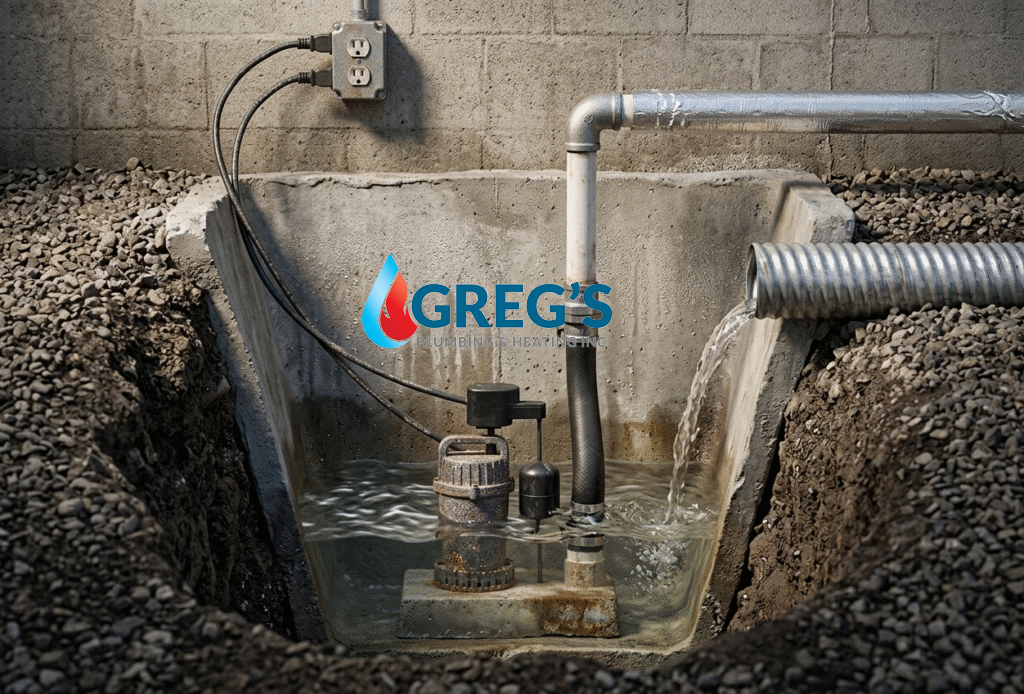
When it rains or snow melts, water saturates the soil around your foundation and drains toward the sump pit through the footing drains. That rising water is normal — the pit is where it collects before being pumped outside.
Your protection is a healthy sump setup: a reliable primary pump, a tight check valve, and a clear discharge that exits outdoors away from the house. Add a battery backup so the pit still empties during a power outage.
If the water level jumps quickly in storms, the pump short-cycles, or the outside discharge keeps getting buried or iced, your system needs attention. Book testing and a tune-up with our Hamilton Plumbers, or go to Emergency Plumbing if water is already rising.
Sewer surge → Backwater valve (your “sewer defence”)
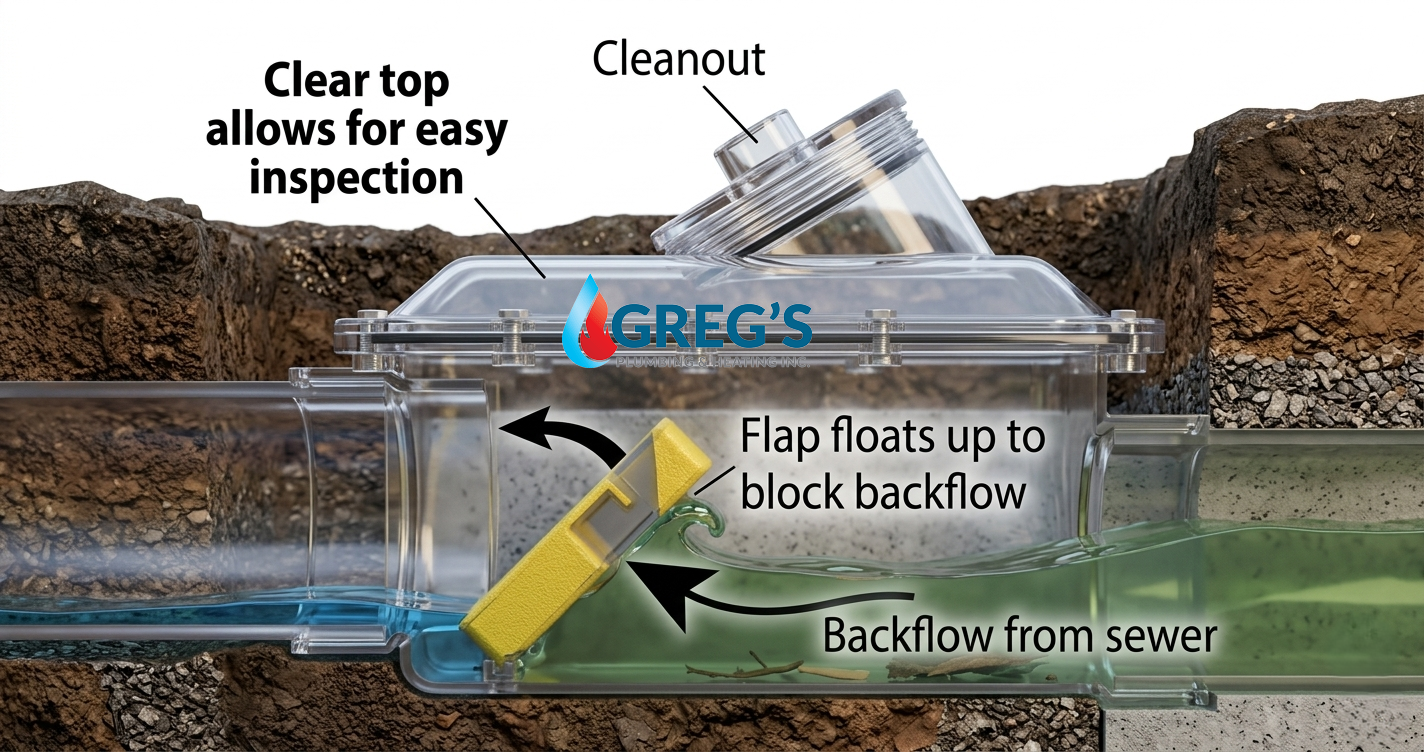
Heavy rain can overload the municipal sanitary sewer and push flow back toward homes. That’s different from groundwater — it comes up through floor drains and fixtures, not the sump pit.
A backwater valve on your sanitary line closes during reverse flow to block sewage from entering the basement. It’s installed with permits and to code, and it complements (not replaces) your sump system.
Clues you’re at risk include gurgling floor drains, foul odours, toilets bubbling during storms, or water appearing from drains. Start with an inspection and options on Sewer Backup Repairs, or Book Online for a same-day visit.
Quick comparison
| Threat | Comes from | What helps | What doesn’t |
|---|---|---|---|
| Groundwater | Soil around foundation | Sump pump, check valve, clear discharge, battery backup | Backwater valve |
| Sewer surge | City sanitary main | Backwater valve, proper branch layout | Sump pump |
Key takeaway: Many Hamilton homes need both: a reliable sump system (often with battery backup) and a backwater valve. One does not replace the other.
3-minute sump test
Do this before the next storm. It’s safe, fast, and tells you if the system will actually move water under load. If water is already rising, use Emergency Plumbing.
Step-by-step (no tools)
1) Power & outlet
Make sure the pump is plugged in, the GFCI isn’t tripped, and the cord/plug is dry and intact.
2) Float test
Fill the pit with a bucket or hose until the float lifts (or lift it yourself). The pump should start, the water level should drop, and you should hear/see water at the outside discharge within ~5–10 seconds.
3) Check valve “thunk”
When the pump stops, you’ll often hear a quick thunk as the check valve closes. That’s normal. No thunk + water falling back into the pit = bad or missing check valve.
4) Quick pit clean
Skim leaves/grit/string. Clear the float path so it can travel freely.
5) Cycle twice
Run the float test two times to confirm reliable start/stop.
What your test results mean
| Result | Likely issue | What to do next |
|---|---|---|
| Pump doesn’t start | Tripped GFCI, failed float, seized motor | Reset GFCI once; if no start, Book Online |
| Pump runs but no discharge | Frozen/blocked line, stuck check valve, jammed impeller | Cut power to avoid burnout; Emergency Plumbing in active floods |
| Water drops then returns | Missing/failed check valve | Replace valve; we stock common sizes on the truck |
| Rapid short-cycling | High inflow, short float travel, small pit | Adjust float, resize pit, or add a secondary pump |
Pro tip: If your pump is 5–7+ years old or you can’t confirm age, schedule a storm-readiness inspection. Start at Hamilton Plumbers.
Do you need a battery backup?
A battery backup keeps water moving when the power fails or the primary pump dies. If any of these apply, add one:
Quick checklist
✅ Finished basement or stored valuables (drywall, flooring, furnace, water heater).
✅ Frequent outages/flickers in storms (escarpment areas, rural edges, Binbrook).
✅ Primary pump ≥ 5–7 years old, unknown age, or getting noisy.
✅ High inflow rate (pit rises quickly in heavy rain).
✅ You’re away often and want text/phone alerts (smart alarms available).
Typical loss scenarios (why backups matter)
| Scenario | What fails | Why backup helps |
|---|---|---|
| Thunderstorm outage | Outlet/GFCI power | Battery runs a dedicated backup pump |
| Primary pump seizure | Motor/impeller failure | Backup takes over automatically |
| GFCI trips overnight | Power present but outlet off | Backup uses separate controller/circuit |
| Frozen/blocked discharge | Flow stalls | Alarm warns you to clear the outlet |
ROI: A backup system costs roughly the price of a mid-range appliance versus $10k–$40k in typical finished-basement damage. See how we install and commission systems in our Testimonials, or get a same-day inspection via Book Online.
Picking a backup: DC battery vs inverter + second pump (pros/cons, runtime)
Two solid ways to stay dry during outages. We install both, depending on pit size, vertical lift, inflow rate, and budget.
Option A — Dedicated DC backup pump + deep-cycle battery
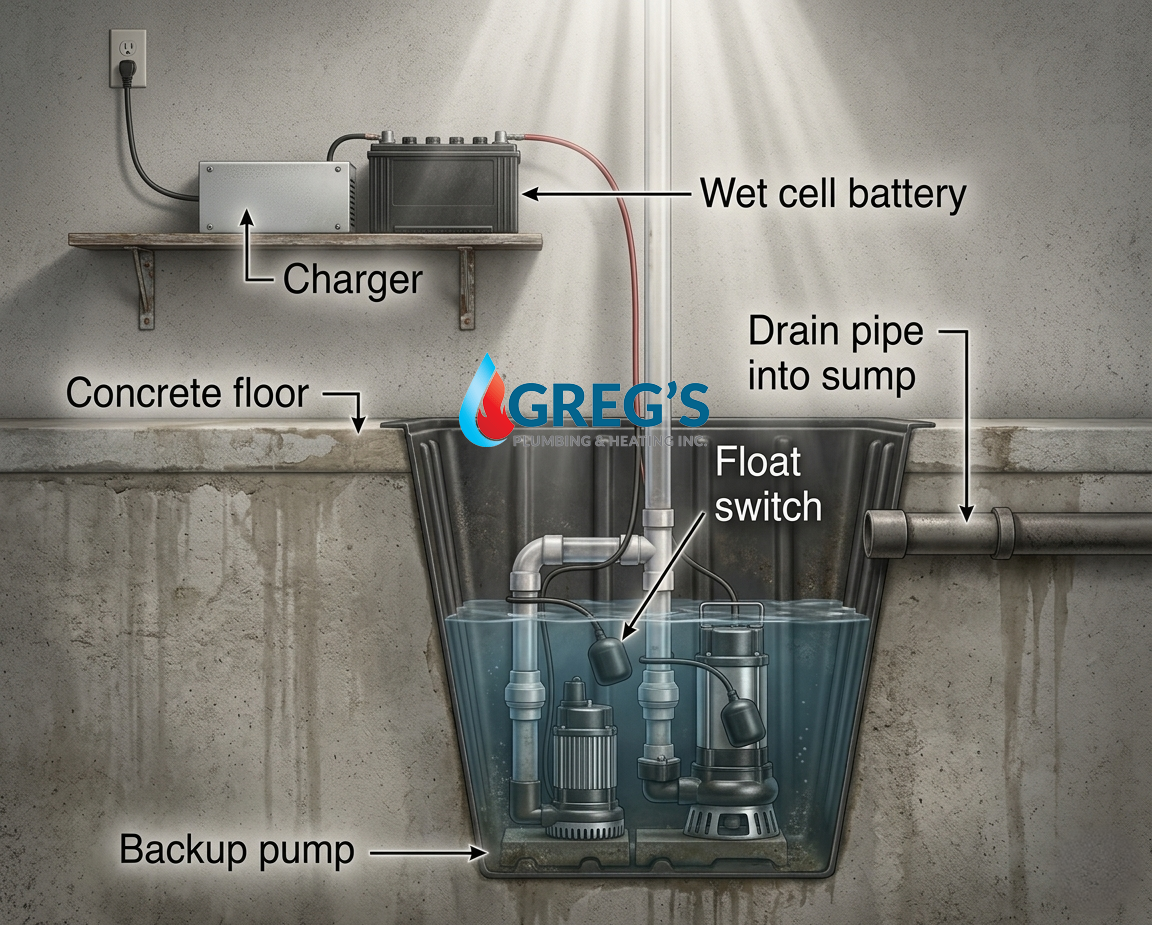
A compact 12/24-volt dedicated backup pump sits beside your primary sump pump with its own float and charger. When the power goes out or the pit rises too high, it auto-starts and moves water even if the main pump fails. It installs fast, fits small pits, and costs less up front. Runtime depends on your battery size (Ah), so plan for your storm duty cycle. Ideal for finished basements with moderate inflow and 6–10 ft vertical lift.
Option B — Inverter + second AC pump (high-capacity)
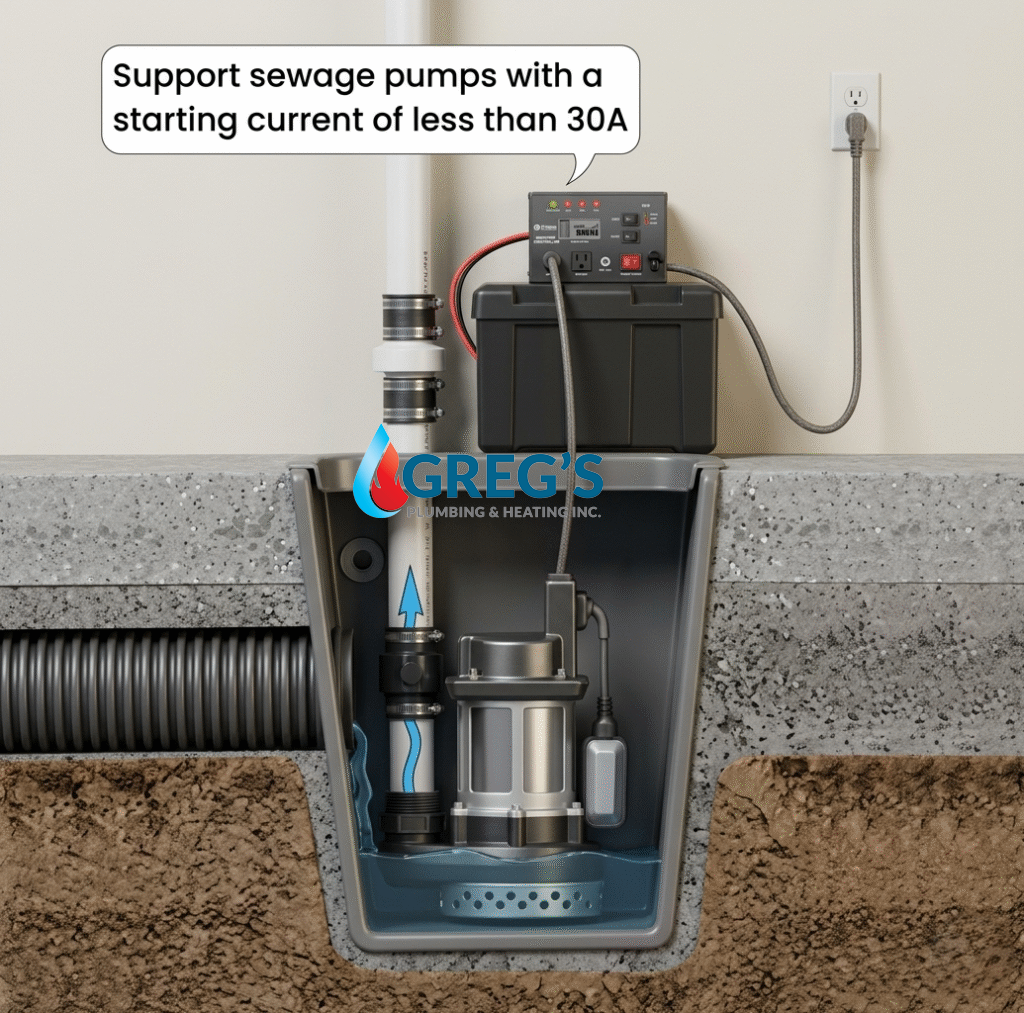
A pure-sine inverter/charger powers a full-size AC sump pump from batteries during outages, so you keep the high GPM of a primary pump. It’s the better choice for deep pits, tall lifts (10–15 ft), or heavy inflow homes in Hamilton that see longer blackouts. It takes more space and budget, but you can scale runtime by adding batteries, giving you hours of protection in severe storms.
Quick comparison
| Feature | DC backup pump | Inverter + AC pump |
|---|---|---|
| Typical flow | Medium | High |
| Footprint in pit | Small | Medium–Large |
| Runtime scaling | Add Ah | Add batteries / higher inverter |
| Upfront cost | Lower | Higher |
| Good for | Most finished basements | High inflow / tall lift homes |
Rule-of-thumb runtime (use our sizer for specifics)
Assumes ~85% system efficiency and 25% duty cycle in a storm.
| Pump power | Battery | Est. runtime |
|---|---|---|
| 600 W | 100 Ah (12 V) | ~6–7 hours |
| 600 W | 2×100 Ah (12 V) | ~12–14 hours |
| 900 W | 100 Ah (12 V) | ~4–5 hours |
| 900 W | 2×100 Ah (12 V) | ~8–10 hours |
Want exact numbers? Use the Sump Pump Test & Backup Sizer, then Book Online and we’ll verify inflow and lift on site.
When to add a backwater valve (and when it won’t help)
A backwater valve protects against sewer surge (the city main pushing wastewater back toward your home). It does not move groundwater—your sump system handles that.
Add a backwater valve if:
- You or close neighbours have had sewer backups during heavy rain.
- You hear gurgling at floor drains or see toilets bubble in storms.
- You’re finishing the basement and want full protection (often paired with a sump upgrade and alarm).
- Your street has older/clay sewers or is on a low point.
Check if you are elligible for a rebate using our Backwater Valve Rebate Checker
A valve won’t help if:
- The problem is groundwater rising in the pit — that’s a sump pump/backup issue.
- The discharge line is frozen/blocked — you still need a clear outlet and working pump.
What’s involved (Ontario basics)
- Locate & camera the sanitary line, confirm placement.
- Permit/code review and installation with accessible clean-out.
- Test operation and provide maintenance guidance (valves need periodic cleaning).
If you’ve had sewer signs, start with our Sewer Backup Repairs page and the First-Hour Checklist. For same-day inspections, 905-928-6831 or Book Online.
What we do on an inspection (flow test, vertical lift, discharge check, power)
Our storm-readiness visit is built to catch failures before the rain.
The checklist we run
- Electrical & GFCI — verify dedicated circuit, test GFCI, confirm clean power to primary and backup.
- Pump health — amp draw, GPM flow test, float travel, impeller inspection; replace worn floats proactively.
- Vertical lift — measure rise from pit to exit; match pump curve to your lift so it doesn’t stall mid-storm.
- Discharge path — check valve condition, unions, exterior outlet (not buried, iced, or aimed at the foundation).
- Pit & lid — remove debris/silt, confirm clearances; recommend sealed/gas-tight lids when needed.
- Backup design — size DC vs inverter solution to hit your target runtime; place high-water alarm.
- Alarms & smart alerts — test audible alarm; offer optional SMS/phone alerts.
- Written installed scope — clear, no-hourly pricing; parts availability and timeline.
Want to see results from nearby installs? Browse Testimonials, then Book Online. If water is already rising, use Emergency Plumbing.
Typical measures we document (you keep the report)
| Item | Target | Why it matters |
|---|---|---|
| Start current / run amps | Within spec | Flags failing motors before they seize |
| Flow at lift (GPM) | Matches storm inflow | Ensures pump can keep up during peaks |
| Check valve drop-back | Minimal | Prevents short-cycling and burnout |
| Duty cycle in rain | < 50% ideal | High duty suggests second pump/backup |
| Battery health (V/Ah) | ≥ 12.6 V rested | Predictable runtime in outages |
FAQs: Sump Pump & Battery Backup
My sump alarm keeps beeping. What does it mean?
Usually high water or low battery on the backup. Check the controller panel. If the pit is rising, stop laundry/dishwashers and call 905-928-6831.
The pump runs but no water appears outside. Why?
Likely a frozen/blocked discharge, a failed check valve, or a disconnected union. Turn the pump off to avoid burnout and use Emergency Plumbing if flooding is active.
The water looks rusty when I test. Is the pump failing?
Rust often comes from steel pits or iron bacteria. We’ll inspect the impeller and flush the pit; the colour alone doesn’t condemn the pump.
How long do sump pumps last?
Typically 5–10 years depending on runtime and debris. Floats fail most often. Annual testing and a battery backup extend protection.
Do I really need a battery backup in Hamilton?
If you have a finished basement, frequent outages, or a pump of unknown/7+ years, yes. It’s inexpensive insurance versus $10k–$40k in typical restoration. See the sizing tool above and Book Online.
Can I tie the sump discharge into the sanitary drain?
No — it’s against code and can cause fines and sewer overloads. Discharge must go outside to grade or an approved storm outlet. We’ll review options during inspection.
Will a backwater valve stop groundwater?
No. Backwater valves stop sewer surge only. Groundwater is handled by the sump system. Many Hamilton homes need both protections. See Sewer Backup Repairs.
Ready to storm-proof your basement? 905-928-6831 or Book Online — Greg’s Plumbing & Heating, 69 Bigwin Rd Unit 1 Hamilton ON • admin@gregsplumbing.ca.


